


Quality check-in
Drew O’Neil discusses fixed income market conditions and offers insight for bond investors.
For many investors, the allocation to fixed income is intended to be the ballast of the portfolio with a primary objective of preserving wealth. Investment-grade bonds, which are those with ratings of Baa3/BBB- or higher, typically make up most, if not all, of many fixed income allocations. Why? Historically, they have done a very good job of preserving wealth. For a buy-and-hold investor who typically holds bonds until they are redeemed, the primary risk of losing principal is an issuer default. How likely is a default when purchasing investment-grade bonds? The chart below provides some data on this topic.
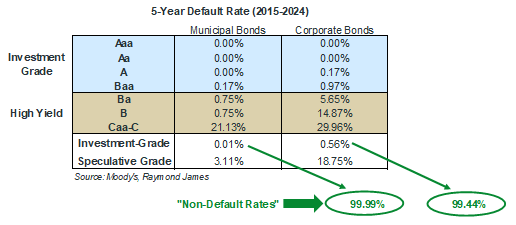
The chart shows the percentage of bonds across the spectrum of ratings categories that defaulted over an average 5-year period from 2015 to 2024 (the most recent data available). For example, 0.17% of A-rated corporate bonds defaulted over any given 5-year period within that timeframe, on average. Given that the default rates for investment-grade bonds are so low historically, it might be more telling to look at the “non-default rate.” For investment-grade municipal bonds, the non-default rate was 99.99% over this timeframe. For investment-grade corporates, it was 99.44%. How effective are investment-grade bonds at preserving wealth for buy-and-hold investors? These numbers hopefully shine some light on the subject.
A note on corporate spreads
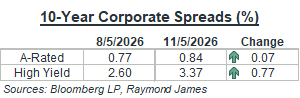
Investment-grade spreads remain near historically tight levels, signaling optimism from the markets as to the overall strength of highly rated corporate issuers. While investment-grade spreads have been fairly consistent over the past year (remaining in a ~20 basis point range), high-yield spreads have been a different story, especially over the past quarter. 10-year, high-yield spreads have widened out by ~77 basis points over the past three months while A-rated spreads are higher by ~7 basis points. While this is somewhat expected, given that high-yield bonds are by nature more volatile, the divergence between high-yield and investment-grade spreads is notable given the media attention that has been dedicated to corporate spreads recently. Oftentimes, the media will portray all corporate bond spreads under a single umbrella, commentating that “corporate spreads have widened out sharply” (or something along these lines) without clarifying that they are referring to high-yield spreads. While investment-grade spreads remain tight, high benchmark (Treasury) yields mean that all-in yields in the corporate bond space are at some of the most attractive levels of the past two decades. Investors are able to lock in these attractive yield levels at a time that, given how tight spreads are, the market is signaling continued strength in the underlying corporate credits.
The author of this material is a Trader in the Fixed Income Department of Raymond James & Associates (RJA), and is not an Analyst. Any opinions expressed may differ from opinions expressed by other departments of RJA, including our Equity Research Department, and are subject to change without notice. The data and information contained herein was obtained from sources considered to be reliable, but RJA does not guarantee its accuracy and/or completeness. Neither the information nor any opinions expressed constitute a solicitation for the purchase or sale of any security referred to herein. This material may include analysis of sectors, securities and/or derivatives that RJA may have positions, long or short, held proprietarily. RJA or its affiliates may execute transactions which may not be consistent with the report’s conclusions. RJA may also have performed investment banking services for the issuers of such securities. Investors should discuss the risks inherent in bonds with their Raymond James Financial Advisor. Risks include, but are not limited to, changes in interest rates, liquidity, credit quality, volatility, and duration. Past performance is no assurance of future results.
Investment products are: not deposits, not FDIC/NCUA insured, not insured by any government agency, not bank guaranteed, subject to risk and may lose value.
To learn more about the risks and rewards of investing in fixed income, access the Financial Industry Regulatory Authority’s website at finra.org/investors/learn-to-invest/types-investments/bonds and the Municipal Securities Rulemaking Board’s (MSRB) Electronic Municipal Market Access System (EMMA) at emma.msrb.org.

Raymond James financial advisors may only conduct business with residents of the states and/or jurisdictions for which they are properly registered. Therefore, a response to a request for information may be delayed. Please note that not all of the investments and services mentioned are available in every state. Investors outside of the United States are subject to securities and tax regulations within their applicable jurisdictions that are not addressed on this site. Contact your local Raymond James office for information and availability.
Links are being provided for information purposes only. Raymond James is not affiliated with and does not endorse, authorize or sponsor any of the listed websites or their respective sponsors. Raymond James is not responsible for the content of any website or the collection or use of information regarding any website's users and/or members.
Investment advisory services offered through Raymond James Financial Services Advisors, Inc.. TowneBank and Towne Wealth Management are not registered broker/dealers and are independent of Raymond James Financial Services. Investment products are: not deposits, not FDIC/NCUA insured, not insured by any government agency, not bank guaranteed, subject to risk and may lose value.
© 2026 Securities offered through Raymond James Financial Services, Inc., member FINRA / SIPC
| Legal Disclosures | Privacy, Security & Account Protection | Terms of Use
Investment and Insurance products are:
- NOT A DEPOSIT
- NOT FDIC-INSURED
- NOT GUARANTEED BY TOWNEBANK
- NOT INSURED BY ANY STATE OR FEDERAL GOVERNMENT AGENCY
- SUBJECT TO RISK AND MAY LOSE VALUE
