


Thoughts on inflation, interest rates and retail sales
Raymond James Chief Economist Eugenio J. Alemán discusses current economic conditions.
This week was a travel week, beginning at the National Association for Business Economics (NABE) annual conference in Cleveland, Ohio, and ending in Phoenix, Arizona, for several advisor and client presentations. As you might expect, the NABE conference was dominated by discussions about AI and its potential impact on long-term economic growth.
We also heard from Cleveland Federal Reserve President Beth Hammack, who entered this year as one of the more outspokenly hawkish members of the Federal Open Market Committee. She has consistently argued for higher interest rates to stay ahead of inflationary pressures, and her remarks at the conference confirmed she remains firmly in that camp. While she acknowledged the challenges facing many households and businesses within her district, she views restrictive monetary policy as necessary.
We understand the Federal Reserve's (Fed) concerns. After all, high inflation disproportionately harms lower-income households, which have limited ability to shield themselves from rising prices. However, as we argued several weeks ago, fiscal policymakers should also bear some responsibility for moderating economic growth. Without greater assistance on that front, the Fed may be forced to tighten policy to a degree that unnecessarily increases recession risks.
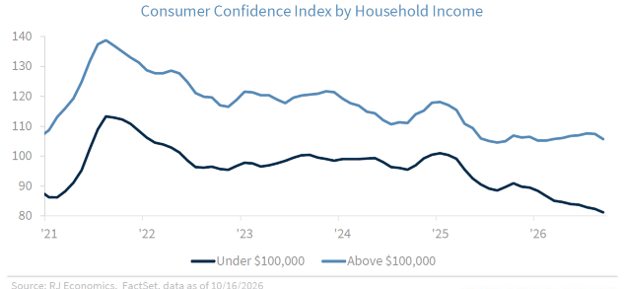
The Fed currently finds itself in a difficult position. Lower- and middle-income households are often the first to be priced out of credit markets when interest rates rise, creating a double burden as they simultaneously contend with higher borrowing costs and elevated prices. The objective of higher rates is to slow demand, but demand is already soft for much of the population. In contrast, the spending power of higher-income households continues to be supported by the same factors that have driven roughly half of all consumer spending in recent years.
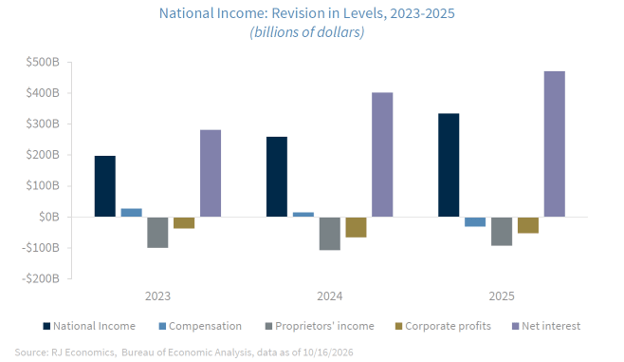
For these households, higher interest rates can actually provide an income boost through increased returns on interest-bearing assets. In that sense, monetary policy may be acting less as a restriction and more as a source of additional income. Combined with gains from wealth accumulation, rising interest income has helped support spending among upper-income consumers. As we noted following the Bureau of Economic Analysis revisions to the national accounts, interest income receipts were revised higher, reinforcing this dynamic. As a result, it is difficult to argue that higher-income households will materially reduce consumption simply because interest rates move higher.
At the same time, consumer sentiment surveys continue to paint a troubling picture. They suggest growing economic anxiety among households and increasing political challenges for the incumbent party heading into the midterm elections. These concerns are not new, but earlier in the year consumers still benefited from lower taxes and larger tax refunds, which helped support spending. Those tailwinds have largely faded.
A recent Harris poll conducted for The Guardian found that three-quarters of Americans are concerned about a recession, while 61% believe the economy is already in one. Among Democrats, the share believing the economy is in recession rose from 67% in the May-June survey to 72% today. Among Independents, it increased from 54% to 61%, while among Republicans it climbed from 39% to 50%.
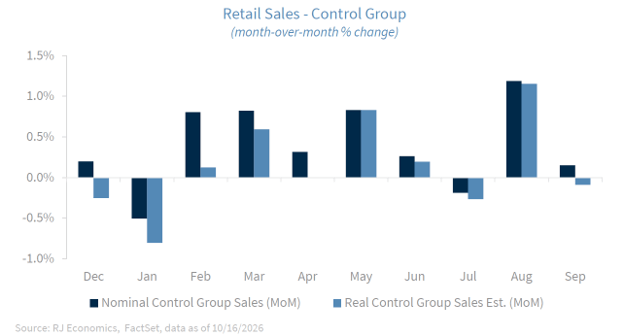
This week's retail and food services report for September may have provided the first meaningful indication that consumers are beginning to feel the effects of higher prices. Headline retail sales increased a strong 0.8% on a month-over-month basis, but that figure was significantly boosted by higher sales at gasoline stations, reflecting rising gasoline prices rather than stronger underlying demand.
Excluding gasoline stations, nominal retail sales rose just 0.2%. More importantly, control group retail sales, which feed directly into personal consumption expenditures in the GDP accounts, increased only 0.1%. After adjusting for inflation, that translates into negative real growth for September.
Although consumer spending remained solid during the third quarter, much of that strength was concentrated in August. Both July and September showed signs of weaker demand. Monthly consumer spending data can be volatile, so one month does not establish a trend. Nevertheless, it is a development worth monitoring closely.
One area that remained resilient was spending at restaurants and bars, where sales rose 1.1% during the month. That result is consistent with the view that higher-income households, which have benefited the most from asset gains and higher interest income, continue to support overall consumer spending.
Bottom line
The Federal Reserve faces an increasingly difficult balancing act as elevated inflation continues to weigh on lower- and middle-income households, while higher-income consumers remain relatively insulated by wealth gains and rising interest income. September’s retail sales report suggests that higher prices may finally be taking a toll on underlying consumer demand, even as nominal headline spending remains strong. With monetary policy more than likely having an uneven impact across income groups, further interest rate hikes risk placing additional pressure on already stretched households without meaningfully slowing spending among higher-income consumers.
Economic and market conditions are subject to change.
Opinions are those of Investment Strategy and not necessarily those of Raymond James and are subject to change without notice. The information has been obtained from sources considered to be reliable, but we do not guarantee that the foregoing material is accurate or complete. There is no assurance any of the trends mentioned will continue or forecasts will occur. Past performance may not be indicative of future results.

Raymond James financial advisors may only conduct business with residents of the states and/or jurisdictions for which they are properly registered. Therefore, a response to a request for information may be delayed. Please note that not all of the investments and services mentioned are available in every state. Investors outside of the United States are subject to securities and tax regulations within their applicable jurisdictions that are not addressed on this site. Contact your local Raymond James office for information and availability.
Links are being provided for information purposes only. Raymond James is not affiliated with and does not endorse, authorize or sponsor any of the listed websites or their respective sponsors. Raymond James is not responsible for the content of any website or the collection or use of information regarding any website's users and/or members.
Investment advisory services offered through Raymond James Financial Services Advisors, Inc.. TowneBank and Towne Wealth Management are not registered broker/dealers and are independent of Raymond James Financial Services. Investment products are: not deposits, not FDIC/NCUA insured, not insured by any government agency, not bank guaranteed, subject to risk and may lose value.
© 2026 Securities offered through Raymond James Financial Services, Inc., member FINRA / SIPC
| Legal Disclosures | Privacy, Security & Account Protection | Terms of Use
Investment and Insurance products are:
- NOT A DEPOSIT
- NOT FDIC-INSURED
- NOT GUARANTEED BY TOWNEBANK
- NOT INSURED BY ANY STATE OR FEDERAL GOVERNMENT AGENCY
- SUBJECT TO RISK AND MAY LOSE VALUE
