


Rising yields may create opportunity rather than signal a bond market crisis
Review the latest Weekly Headings by CIO Larry Adam.
Key takeaways:
- Warsh has an opportunity to provide greater clarity at Jackson Hole
- Growth remains resilient, but the tailwinds are likely to fade
- While inflation remains elevated, the outlook is expected to improve
For the past five weeks, markets have been focused on a steady stream of corporate earnings, supported by upbeat management commentary and another quarter of strong results. But with second quarter 2026 earnings season nearing its end, investors' attention is shifting back to the macro backdrop.
The good news: The economy, while slowing modestly, remains resilient, and the S&P 500 continues to hover near record highs. The challenge: Government bond yields around the world have climbed to multi-year highs, and the persistence of the move is becoming harder to ignore. With the national debt surpassing $40 trillion, the AI spending boom fueling a surge in corporate bond issuance, and markets testing the new Federal Reserve (Fed) chair’s inflation-fighting resolve, investors are increasingly asking how much further yields can rise. Below, we explain why the recent rise in yields may be creating opportunity rather than signaling a bond market crisis.
Higher yields, better opportunity?
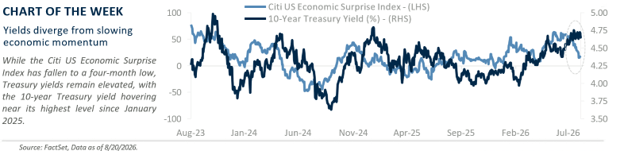
Bond yields have drawn much attention lately, and for good reason. The 30-year Treasury yield climbed above 5.3% this week, its highest level since 2007, while the 10-year Treasury yield reached its highest level since January 2025. Although the nation’s fiscal challenges and growing competition for capital as mega-cap tech companies tap the bond market to fund the AI buildout are legitimate concerns, the path of yields will ultimately depend on where the two key drivers – growth and inflation – head in the months ahead.
The market is testing Warsh
History suggests markets often test new Fed chairs early in their tenure. Sometimes the challenge comes from equities, as both Greenspan (Black Monday) and Powell (Volmageddon) faced bouts of market volatility that tested the Fed’s response. Other times, it comes from bonds. Volcker, for example, faced a test of his inflation-fighting credibility and ultimately raised rates as high as 20% to restore price stability.
Today, part of the rise in long-term Treasury yields reflects uncertainty around the Fed’s evolving policy framework and Chair Warsh’s ambiguity during his first two post-FOMC press conferences. That makes next week’s Jackson Hole speech an important opportunity to provide greater clarity on the Fed’s reaction function. While Warsh is unlikely to offer near-term rate guidance given his desire to move away from forward guidance, more transparency around the framework could help steady markets.
Tailwinds to growth will fade
Despite higher energy prices and subdued sentiment, the US economy has shown remarkable resilience this year, supported by larger than expected tax refunds and robust AI-related investment. As a result, nominal GDP growth has accelerated to 6.5% year over year, its fastest pace since the third quarter of 2023, helping push the 10-year real yield to roughly 2.4%, near its highest level since 2008.
Looking ahead, however, these tailwinds are likely to fade. With much of the tax-cut benefit front-loaded into the first half of 2026, fiscal support should diminish in second half of 2026 as the personal savings rate remains near multi-year lows. Higher real yields should also act as a natural brake on activity, helping cool growth without Fed intervention. Early signs of moderation are already emerging. The Citi US Economic Surprise Index has fallen to a four-month low, accompanied by recent downside surprises in employment growth and retail sales.
Meanwhile, rate-sensitive areas such as housing continue to face pressure from elevated borrowing costs. While we still expect positive growth in 2026 (Raymond James GDP estimate: +2.3%), a slower pace of expansion should help cap further increases in yields and support lower Treasury rates in the months ahead.
Inflation pressures still likely to ease
Heading into the year, the Fed expected core inflation to ease to 2.5% by the end of 2026 as tariff effects faded, paving the way for additional policy easing. Instead, the unexpected US-Iran conflict sent oil prices soaring as much as 86% at their peak, reigniting inflation pressures.
While oil has fallen from its high ($113 per barrel), core Personal Consumption Expenditures (PCE), the Fed’s preferred inflation gauge, accelerated to 3.3% year over year in May, near its highest level in three years. Inflation concerns, coupled with the Fed’s hawkish pivot, have been key drivers of higher yields this year.
Looking ahead, however, we expect the inflation outlook to improve. Potential catalysts include a resolution to the US-Iran conflict (hopefully), continued restraint in shelter costs, slower economic growth, favorable year-over-year tariff comparisons and planned changes to the PCE calculation. As a result, we expect the disinflation trend to reassert itself by early fall (Raymond James 2027 year-end core PCE estimate: +2.2%). Importantly, with wage growth slowing to 3.2% year over year, a five-year low, longer-term consumer inflation expectations remain anchored near the Fed’s 2% target. Easing inflation pressures should remove a key source of upward pressure on Treasury yields.
Bottom line
While the steady rise in yields since the onset of the US-Iran conflict has pushed the 10-year Treasury yield toward the upper end of the 4%-5% range we outlined at the start of the year, we believe additional upside is limited.
With yields now at increasingly restrictive levels, growth tailwinds fading and inflation pressures likely to ease, the backdrop for fixed income is becoming more supportive. While fiscal challenges and heavy corporate bond issuance may limit how far yields fall, demand for US Treasuries and corporate debt at these elevated levels remains healthy. Therefore, we continue to see room for lower rates as economic fundamentals evolve in the months ahead. At current levels, we believe high-quality bond yields offer an attractive entry point for long-term investors.
All expressions of opinion reflect the judgment of the author(s) and the Investment Strategy Committee and are subject to change. This information should not be construed as a recommendation. The foregoing content is subject to change at any time without notice. Content provided herein is for informational purposes only. There is no guarantee that these statements, opinions or forecasts provided herein will prove to be correct. Past performance is not a guarantee of future results. Indices and peer groups are not available for direct investment. Any investor who attempts to mimic the performance of an index or peer group would incur fees and expenses that would reduce returns. No investment strategy can guarantee success.
Economic and market conditions are subject to change. Investing involves risks including the possible loss of capital.
The information has been obtained from sources considered to be reliable, but we do not guarantee that the foregoing material is accurate or complete. Diversification and asset allocation do not ensure a profit or protect against a loss.
The S&P 500 Total Return Index: The index is widely regarded as the best single gauge of large-cap U.S. equities. There is over USD 7.8 trillion benchmarked to the index, with index assets comprising approximately USD 2.2 trillion of this total. The index includes 500 leading companies and captures approximately 80% coverage of available market capitalization.
Sector investments are companies focused on a specific economic sector and are presented here for illustrative purposes only. Sectors, including technology, are subject to varying levels of competition, economic sensitivity, and political and regulatory risks. Investing in any individual sector involves limited diversification.

Raymond James financial advisors may only conduct business with residents of the states and/or jurisdictions for which they are properly registered. Therefore, a response to a request for information may be delayed. Please note that not all of the investments and services mentioned are available in every state. Investors outside of the United States are subject to securities and tax regulations within their applicable jurisdictions that are not addressed on this site. Contact your local Raymond James office for information and availability.
Links are being provided for information purposes only. Raymond James is not affiliated with and does not endorse, authorize or sponsor any of the listed websites or their respective sponsors. Raymond James is not responsible for the content of any website or the collection or use of information regarding any website's users and/or members.
Investment advisory services offered through Raymond James Financial Services Advisors, Inc.. TowneBank and Towne Wealth Management are not registered broker/dealers and are independent of Raymond James Financial Services. Investment products are: not deposits, not FDIC/NCUA insured, not insured by any government agency, not bank guaranteed, subject to risk and may lose value.
© 2026 Securities offered through Raymond James Financial Services, Inc., member FINRA / SIPC
| Legal Disclosures | Privacy, Security & Account Protection | Terms of Use
Investment and Insurance products are:
- NOT A DEPOSIT
- NOT FDIC-INSURED
- NOT GUARANTEED BY TOWNEBANK
- NOT INSURED BY ANY STATE OR FEDERAL GOVERNMENT AGENCY
- SUBJECT TO RISK AND MAY LOSE VALUE
