


Market focus shifts from earnings to macro catalysts
Review the latest Weekly Headings by CIO Larry Adam.
Key takeaways:
- Despite headwinds from higher oil prices, economic growth remains strong
- The labor market has stabilized after last year’s slowdown
- Inflation is heading in the wrong direction after five years above the Fed’s 2% target
Geopolitical risks are still lingering in the background, but the story lately has been all about earnings. A strong 1Q26 season, paired with a steady drumbeat of upbeat management commentary, has helped push the S&P 500 to 21 record highs this year. But as earnings calls wind down, the market’s focus is shifting back to the bigger picture: the macro backdrop. And there’s no shortage of catalysts ahead.
In the coming weeks, investors will be navigating several key developments that could reintroduce volatility, including the prospect of a deal to end the war in Iran, fresh reads on inflation and the labor market, and the June 16-17 Federal Reserve (Fed) meeting, where Kevin Warsh will debut as chair alongside a rate decision and updated Summary of Economic Projections.
Below, we highlight where the economy stands, the key data points shaping the narrative, and the biggest risks markets may face in the weeks and months ahead.
Growth remains resilient
Despite headwinds from rising fuel costs and softer consumer sentiment, the economy is expanding at a solid pace. Growth is on track to reach 2.4% in 2026, modestly above potential, supported by strong AI-driven business investment and resilient consumer spending. On the business side, investment is emerging as a powerful driver of growth. Hyperscaler capex is projected to reach $720 billion in 2026 and surpass $1 trillion in the years ahead as companies build out artificial intelligence (AI) infrastructure. This surge in spending is already having a meaningful impact, contributing more than a full percentage point to Q1 gross domestic product (GDP). On the consumer side, near-term spending remains supported by higher tax refunds, helping to cushion the drag from weaker sentiment and elevated fuel costs.
- Key data points: Next week’s ISM Manufacturing and Service Surveys that are solidly expanding, pointing to continued resilience.
- Biggest risk: With the consumer accounting for roughly 70% of the economy, its health remains a key focus. So far, households have largely absorbed higher energy prices and cost-of-living pressures. But as the boost from tax refunds fades and disposable personal income declines (currently the lowest since 2022), spending could begin to moderate in the months ahead. That said, strong equity market gains should continue to support upper-income households, with the top 10% still driving roughly 50% of total consumer spending.
Labor market has stabilized
While the job market remains stuck in a low-hire, low-fire environment, labor conditions appear to have found their footing after last year’s slowdown. Despite high-profile layoff announcements (including Meta, UPS, and Amazon) and ongoing concerns around AI-driven disruption, initial jobless claims remain near historically low levels. At the same time, payroll growth continues to show resilience, with gains above 100,000 in each of the past two months – well above the average monthly increase of only 10,000 in 2025. The unemployment rate has held steady at 4.3%, while wage growth is running at 3.6% year over year – just above its longer-run historical average.
- Key data points: Ahead of the Fed’s June meeting, the ISM employment sub-indices and another labor market release on June 5 will provide further clarity. Consensus estimates point to a modest stepdown from the prior two months to roughly 93,000. However, with labor force growth essentially flat – driven by an aging population and low net migration – this pace is broadly consistent with a stable labor market.
- Biggest risk: Concerns that AI will displace some jobs and slow hiring are real. But while AI efficiency gains will reshape certain roles – and eliminate some – most workers are likely to become more productive, which ultimately supports growth via more output per worker. At the same time, new roles tied to AI – such as prompt engineers, quality control and compliance – are already emerging. And importantly, there’s still strong demand across healthcare, hospitality and the skilled trades (think HVAC, plumbing, and electrical). That should help keep overall job growth healthy, with an average of roughly 70,000 per month through the rest of the year.
Inflation is heading in the wrong direction
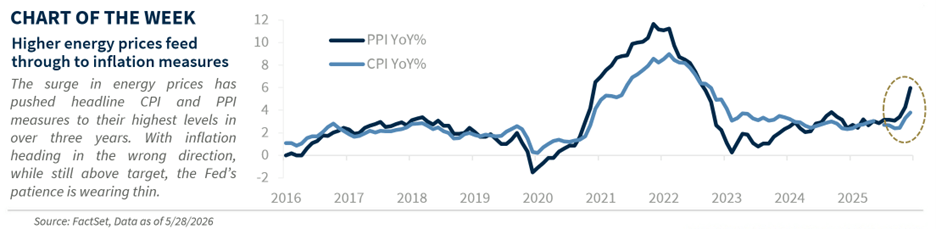
With inflation running hotter than expected, it has become a central concern in 2026. While tariff effects should fade, the war in Iran has introduced a new source of pressure. Surging energy prices have pushed headline inflation to 3.8% – the highest since 2023 – and driven the fastest two-month acceleration in nearly four years. Price pressures are broadening, with ISM price sub-indices at a four-year high and consumer inflation expectations moving higher. After five years above the Fed’s 2% target, policymakers’ tolerance for another overshoot is wearing thin, and markets are pricing in a rate hike this year (we still expect one rate cut).
- Key data points: The market will receive several key updates on inflation in the weeks ahead, including the ISM price indices – key leading indicators of pipeline inflation pressures – on June 1 (manufacturing) and June 3 (services), and the CPI and PPI reports on June 10 and 11.
- Biggest risk: Oil near $100/barrel could pose a risk if the Iran conflict extends beyond the summer. However, our base case is that a deal, hopefully by July or earlier, will lead to a relatively swift move back below $80. A combination of improving supply dynamics should support that decline, including the reopening of the Strait of Hormuz, expanded export capacity (such as the Saudi East-West pipeline), increased output from the United Arab Emirates following its exit from OPEC, and stronger production from non-OPEC producers, like the US and Canada.
*MAGMAN represents a composite of Microsoft, Apple, Google, Meta, Amazon, Nvidia.
All expressions of opinion reflect the judgment of the author(s) and the Investment Strategy Committee and are subject to change. This information should not be construed as a recommendation. The foregoing content is subject to change at any time without notice. Content provided herein is for informational purposes only. There is no guarantee that these statements, opinions or forecasts provided herein will prove to be correct. Past performance is not a guarantee of future results. Indices and peer groups are not available for direct investment. Any investor who attempts to mimic the performance of an index or peer group would incur fees and expenses that would reduce returns. No investment strategy can guarantee success.
Economic and market conditions are subject to change. Investing involves risks including the possible loss of capital.
The information has been obtained from sources considered to be reliable, but we do not guarantee that the foregoing material is accurate or complete. Diversification and asset allocation do not ensure a profit or protect against a loss.
The S&P 500 Total Return Index: The index is widely regarded as the best single gauge of large-cap U.S. equities. There is over USD 7.8 trillion benchmarked to the index, with index assets comprising approximately USD 2.2 trillion of this total. The index includes 500 leading companies and captures approximately 80% coverage of available market capitalization.
Sector investments are companies focused on a specific economic sector and are presented here for illustrative purposes only. Sectors, including technology, are subject to varying levels of competition, economic sensitivity, and political and regulatory risks. Investing in any individual sector involves limited diversification.

Raymond James financial advisors may only conduct business with residents of the states and/or jurisdictions for which they are properly registered. Therefore, a response to a request for information may be delayed. Please note that not all of the investments and services mentioned are available in every state. Investors outside of the United States are subject to securities and tax regulations within their applicable jurisdictions that are not addressed on this site. Contact your local Raymond James office for information and availability.
Links are being provided for information purposes only. Raymond James is not affiliated with and does not endorse, authorize or sponsor any of the listed websites or their respective sponsors. Raymond James is not responsible for the content of any website or the collection or use of information regarding any website's users and/or members.
Investment advisory services offered through Raymond James Financial Services Advisors, Inc.. TowneBank and Towne Wealth Management are not registered broker/dealers and are independent of Raymond James Financial Services. Investment products are: not deposits, not FDIC/NCUA insured, not insured by any government agency, not bank guaranteed, subject to risk and may lose value.
© 2026 Securities offered through Raymond James Financial Services, Inc., member FINRA / SIPC
| Legal Disclosures | Privacy, Security & Account Protection | Terms of Use
Investment and Insurance products are:
- NOT A DEPOSIT
- NOT FDIC-INSURED
- NOT GUARANTEED BY TOWNEBANK
- NOT INSURED BY ANY STATE OR FEDERAL GOVERNMENT AGENCY
- SUBJECT TO RISK AND MAY LOSE VALUE
